
Obesity is a disorder of excess fat accumulation.
Obesity arises because ‘calories in’ is greater than ‘calories out’.
Which one of the above statements is true?
Are they both true?
Do fat people just eat too damn much or do they just store fat easier than everyone else?
What if you couldn’t get fat on a high-fat/low-carb diet?
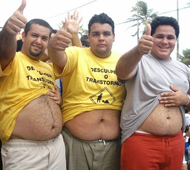 Here I’ll attempt to lay out the case that the above statement is absolutely true. Eat fat (and lots of it if you like) with low carbs and you won’t gain any fat. If this is your first exposure to this idea, keep an open mind – it’s good news!
I’ll lay this out step by step. It’s a little technical but hopefully I describe it in such a way the makes logical sense.
The Case For A High-Fat Diet
Calories In / Calories Out are NOT Independent Variables – We need to stop thinking about them as if they are. When you eat less your metabolism slows to compensate for this. That’s why Low Calorie (semi-starvation) diets are not a permanent solution for weight loss. So ‘Calories In/Calories Out’ affect each other.
Obesity is a Disorder of Excess Fat Accumulation – Obese people are physiologically different in that they store fat much more easily than others. Saying that fat people are fat because they eat more calories than they expend is akin to saying alcoholics are alcoholic because they drink too much! We need to understand the cause of excess fat accumulation.
What Then Regulates the Fat Tissue? If understanding what causes the body to want to store excess fat holds the key, what regulates this process? The answer is that the main regulator is Insulin. As insulin in the body increases, lipolysis (burning fat for fuel) decreases. Why? First a few technical notes:
* There are 2 forms of fat; fatty acids and triglycerides
* Fat is stored in the cells as triglyceride which is 3 fatty acids bound together by a glycerol molecule
* Fat is burned for fuel as fatty acids. Fat also enters and exits the cells as fatty acids.
* Fat in the fat cells is in a constant state of flux (cycling) i.e. fat goes into and out of the cells continuously. This is called the triglyceride/fatty acid cycle.
* If more triglyceride is falling apart into fatty acid, you’re losing fat. If more fatty acids are binding together to triglyceride, you’re gaining fat.
With me so far? Ok, the pivotal role is played by a molecule called alpha-glycerol phosphate. Without this there is no glycerol to bind fatty acids to triglyceride i.e. fat cannot be stored in the fat cells. The more of it you have, the more fatty acids can be stored as triglyceride in the fat cells. So, where does alpha-glycerol phosphate come from?
Alpha-glycerol phosphate comes from burning blood sugar (glucose). The more blood sugar is driven into fat cells and burned for fuel, the more alpha-glycerol phosphate will be available. The more Alpha-glycerol phosphate available, the more fat can be deposited.
Bear with me, we’re nearly there 😉 . Therefore, whatever works to transport glucose into fat cells, works to deposit fat and keep it there! This is exactly what insulin does i.e. it transports glucose into fat cells. High insulin levels are therefore not what we want when our goal is to lose fat.
 What Causes High Insulin Levels? Insulin is secreted by the pancreas in response to the carbohydrates in our diet. Large amounts of carbohydrates raise blood sugar and cause this release of insulin.
Conclusion
It is therefore true that insulin regulates fat metabolism and that carbohydrates drive insulin secretion. It is then also fair to say that carbohydrates drive obesity.
“But a low-carb diet is by definition high in fat, so can’t I get fat even without the carbs?”
As alluded to earlier, without alpha-glycerol phosphate present, fatty acids cannot be bound into triglyceride (which is stored body fat). Therefore: (and this wraps it up)
You cannot gain fat on a high fat/low carb diet.
Enjoy the following video. It’s from Gary Taubes, author of Good Calories, Bad Calories
Stay Thin & Stay Motivated
Mark McManusimage credits miamifeeder and lorimarsha

Great post, Mark! Really helped me understand the relationship between carbs and insulin and weight loss. But you say to avoid so much cardio? Weight loss is very important right now for me, how much cardio should I be doing? I have a very physical job during the summer and that will be my cardio (for at least 4 hours a day of brisk walking) will this hinder muscle growth?
Hi Jay,
This post is about ‘not gaining fat’ as opposed to actually losing it, they are different goals.
Cardio should play a role in fat loss but not intense cardio for long periods. That will break down your muscle tissue. Your brisk walking sounds fine, don’t be concerned about it.
Thanks,
Mark
As you said this post is about not gaining fat. So those people eating low carb and trying to lose weight sometimes they find they need to decrease calories if weight is stalling?? So do calories come in play in this case?
Yes I believe so Sue.
Remember, we want more triglycerides breaking down to fatty acids to be used for energy. If there is sufficient energy for the body’s needs coming from dietary fat, the fatty acids get re-esterified to triglycerides and put back into the fat cells – No Weight Gain but No Weight Loss either.
Cutting calories but more specifically dietary fat (but not in substantial amounts) will take cure of a stall. Remember it’s all about encouraging that body fat to come off and stay off.
This is a critical component of the dietary system in my book ‘Total Six Pack Abs’ where getting single digit body fat is the goal. Telling people to simply cut carbs is not good enough in this case.
Hope that helps Sue and let me know if you need anything else.
Mark
Hey Mark, great post here. While we’re on the issue of calories, where would you suggest someone start with for maintaining scale weight but losing body fat? The Anabolic Diet by DiPasquale states 18x’s bodyweight, but that seems a little high to me. Thanks.
Hi Paul.
Do you mean maintain lean muscle mass while losing fat?
I’m a very optimistic guy but maintaining scale weight while losing fat is unrealistic I’m afraid, let me explain.
You can easily lose 6 or more pounds in a couple of weeks. To maintain scale weight, you’d have to gain 6 or more pounds of muscle in just 2 weeks, and keep gaining at this rate! I think Pasquale was referring to muscle mass as opposed to scale weight, but let me know if you have a source so I can check it out myself.
Make your goal to maintain or even build muscle while losing fat, don’t judge your progress solely by the scales Paul. Get some body fat calipers and some measuring tape to use in conjunction with the scales.
Hope that helps,
Mark
The metabolism of fat is different with and without carbohydrates, true. As you and others who advocate high-fat, low-carb diets constantly point out carbohydrates stimulate insulin and the insulin ushers excess calories into fat cells.
That’s better than the alternative.
What is typically not discussed is the metabolism of fat without insulin, i.e., where and how fat is stored when the amount eaten is greater than the amount needed to meet energy demands.
Fat is still stored without insulin, but in organs, e.g., the liver and the heart, where fat accumulation damages the organs. I fail to understand how people can study high-fat, low-carb diets so meticulously – down to the umpteenth biochemical process – and inocently overlook this aspect of fat metabolism – it’s biochem 101.
Better for EXCESS calories to be stored as triglycerides in fat cells … best though is not eating more than one needs.
Fat is not stored as muscle in muscle tissue – no amino acids. Fat is not simply excreted if it cannot be stored in fat cells (this has been shown in studies). A high-fat, low-carb diet that exceeds energy needs is simply a faster way to damage organs than eating too many calories with carbs. (Those with fewer fat cells who overeat damage their organs faster due to fats being stored in organs instead of in fat cells – google it.)
The best way to use fat for energy is not to avoid carbs and “reach ketosis,” but to engage in fat-burning (aerobic or “cardio”) exercises – daily. This will strengthen muscles (a great deal of muscle fibers are slow-twitch, aerobic fibers), build greater bone density and achieve numerous other health benefits, e.g., good mental health.
Athletes are living proof of this as most of us – who are the leanest in our society – eat high-carb diets, lean meats, and get adequate Omega-3 fatty acids – not sat fats that indirectly promote arterial plaque (“bad” and “high” cholesterol are hype, but so is the notion of a “low-carb” diet).
I do not doubt your sincerity, but in your elucidation of biochemical processes of fat metabolism you left out such facts as excess fat is stored in organs without insulin to usher fat into fat cells – where excess calories (if you must eat them) belong. Thanks for listening.
That Gary Taubes is really something else eh? Another funny thing is that a lot of prosperous hunter tribes really did grow a lot vertically… presumably due to the very hormone cocktail your bodybuilding diet seeks to increase – growth hormone, testosterone, IGF-1, high mineral and fat soluble-vitamin intake. Very anabolic stuff.
Just to get this straight: Once ketosis has begun, I can eat all the fats and proteins I want, and I won’t get fat? I’m going to try it, but I’ve heard people say that you need to still watch your caloric intake, and I want to be sure that I know what’s going to happen before I eat a larger number of calories than my BMR+cardio.
And @ Zach,
“Fat is still stored without insulin, but in organs, e.g., the liver and the heart, where fat accumulation damages the organs. I fail to understand how people can study high-fat, low-carb diets so meticulously – down to the umpteenth biochemical process – and inocently overlook this aspect of fat metabolism – it’s biochem 101.”
Citation please? Perhaps a Stryer reference? I’m not a biochemist, but I’d like something a bit less hand-wavy. You make good questions, but I’d like an answer. Thanks.
Thanks Mike 🙂
@ Daniel. Possibly, all is not known about this yet. As for ‘excess’ fat calories being stored in organs. The body can ‘waste’ unwanted calories through futile cycling. On top of that, it’s damn hard to overconsume fat on this diet, most people actually unintentionally create a calorie deficit on a low-carb diet due to its satiating effects. Also, if you look at comparative studies, low carb diets at the very least do as well as low fat ones in decreasing heart-risk factors, and a lot of the time they do MUCH better especially in reducing circulating tyiglycerides.
Mark
In response to Zachary Cabon’s comment, I have a few questions, which hopefully Mark will address.
I’ve been doing a CKD for a few months now, and just recently became serious about gaining more weight. So I had to up the calories. Currently I’m 5′ 10″, around 175 pounds, with around 10% bf, and I have been eating around 4000 calories for the past couple weeks.
My real question is how do I know if I’m eating too much fat? I want to eat enough to gain more muscle, but the risk of damage to the organs doesn’t sound very good 🙁
Daniel
Did you ask advocates of low-carb diets, who offer biochemical elucidations, if they could provide references from Stryer?
Just curious.
Stryer is not “biochem 101” (he’s senior biochemistry). Since you know his textbook, you know that :^ )
Stryer covers biochemistry in a healthy state and in some disease states. He does cover starvation, but “eating all the protein and fat you want,” which is literally advocated in many low-carb diet books, is not starvation.
I wish we could open a Stryer textbook, flip to the index and look up “low-carb diets,” or similar. But as you know, Stryer had a lot of ground to cover without reviewing “unbiased” studies by the Atkins Foundation.
Reviewing literature on fatty acid and triglyceride metabolism apart from Stryer’s textbook is possible. Here is an example you requested:
https://www.sciencedaily.com/releases/2008/04/080416110120.htm
The adverse effects of fatty-acid deposits in non-adipose tissues is “biochem 101” when we consider Type II Diabetes and its many secondary medical conditions.
Why did I study lipid metabolism from the ‘low-carber’s’ POV?
I am not selling that diet. I am not going on that diet. Why should I research biochemical processes related to lipid metabolism during lower ratios of anabolic hormones, e.g., insulin?
I researched this topic because of the claims I saw by authors of low-carb diet books, e.g., by Michael Eades, MD (nice guy, btw). Eades wrote in his blog to his “patients,” or to his “customers” (unclear line there), they could eat all the fat they wanted and if they were gaining weight, then it must be muscle weight because there was no way the triglycerides could enter the adipocytes without insulin … words to that effect.
Should we ask him for a reference from Stryer?
How would athletes develop muscle glycogen during a constant low-ratio of anabolic (e.g., insulin) to catabolic hormones (for all you bodybuilders out there)? Well, Eades stated they would not (which we know to be true). So, why is a bodybuilding Website promoting a low-carb diet?
Triglycerides and free fatty acids can enter cells and supply mitochondria without insulin (which is the whole point of books like “Protein POWER”).
According to Eades (sound reference?) excess lipids (beyond energy requirements) are going into non-adipocytes, i.e., into cells of all organs. I fail to see why Eades finds that desirable.
Personally, if I overate (which I don’t), then I would rather excess lipids be stored in adipocytes (where they would remain dormant until I turned the energy balance around).
Futile cycles? If obese people had significant futile cycles (e.g., supernatural levels of BAT), then why would they be obese in the first place?
What we want is truth about health, not claims based on entrepreneur references about “weight” or about “big muscles.”
IF a low-carb diet (thus high in other macronutrients) leads to: 1) Bone demineralization (balancing a lower blood pH, such as in ketoacidosis); 2) Increased oxidative damage to cells (the antioxidants in fruits and vegetables were thrown out along with their carbs); 3) Increased inflammatory responses (allergens are typically proteins, peptides and amino-acid sequences); and 4) Adverse side effects ranging from physical to mental health problems, then do we really want to advise – without discretion – all people eat low-carb diets?
I agree with Eades on various points, e.g., Omega-3 fatty acids are desirable, daily exercise is desirable, routine high-intensity exercise (on an individual basis) is desirable, and the National Cholesterol Guidelines are poppycock and were ‘purchased’ by Pharma, but why does Eades not wonder if excess fat and protein in a metabolic state with a consistently low ratio of anabolic hormones, e.g., insulin, pose risks?
SOME people may have excessive insulin responses to ordinary levels of carbohydrate consumption, and those people may benefit from reducing carbohydrates; but there’s no benefit from excessive fat and protein consumption.
For the rest of us…
If an energy-balanced diet with a high ratio of carbohydrates is harmful, then why do we enjoy good health, sound fitness and normal cognitive function? Why are most athletes successful on high-carb diets, even in advanced age?
How do the authors of low-carb diet books explain us away?
Is empirical knowledge not a valid reference?
Thanks for being patient with me.
Hey Mark,
Well if we have a high fat diet, then where does the excess fat go? Doesn’t it just convert into stored fat?
Thank you
James
@James. The question being asked in the article is really, ‘Can there be any excess fat in the first place’ in this type of diet?
Or does the body deal with this energy by ‘wasting’ it – futile cycling, I go into it a little bit in my abs book.
Truth is, I don’t know for sure, no-one does (although everyone seems to have an opinion).
At least anecdotally, myself and others have found it impossible to gain fat despite chugging down cream, butter and steaks.
Hopefully time will give us a definitive answer on this.
Mark
Thanks for the answer – just one more question though.
What is the fat/protein/carbs ratio for the MANS diet?
Thanks again!
James
Of course what few people talk about it here is the being realistic part of staying on a low carb diet. It has been shown that low carb diets do make you thinning because the body is breaking down fat etc. One problem though…..do you think most people can stay on a diet like that? When people are on diets like that they are constantly haha craving carbs omg what a surprise. How about this: genetics certainly play a role in weight but so does the environment, just look at Japan. How about follow the food guide pyramid specifically Canada’s; eat healthy, MOSTLY FRUITS, VEGETABLES, AND WHOLE GRAINS. Not enriched and bleached flower but whole freaking grains, and lots of fruits and veggies is what the pyramid recommends. In fact most of what you eat according to the pyramid of any one food type is fruits and veggies but how many people do that? Then eat smaller amounts of Protein and Fat like Eggs and lean meats like Fish i.e. FOLLOW WHAT THEY DO IN JAPAN since they have some of the lowest obesity/highest life expectancy rates-Japan actually because of their environment follows the food guide well. Then eat all you want of these “healthy foods”. Diets are also about how they make you feel right? If you are craving carbs or more food all the time, then the diet was no success. Eat all you WANT but eat like they do in Japan. Then get 30 minutes of exercise rigorously a day or more if possible even if it’s walking. If you still can’t lose weight doing the above stop beating yourself up. Trust me you’re doing the best you can with your genetics. I can tell you there are a lot of factors that play into this that this video doesn’t even talk about like LEPTIN and body weight SET POINT look them up if you’re really curious.
hi Mark i have one question do i need to count the fats or is there is a specific amount i should be taking each day?
hey mark,
i was wondering.
say you reach your goal of 10% bodyfat. and you are now eating 70 grams of dietary fat.
if you increase your fat after you reach your goal while maintaining lo carb, would you gain back some weight?
this has been bugging me for some time. please help
Zachary Cabon just pwned Mark and Mark doesn’t even reply. High fat diets on ice cream and red meat will kill you if you don’t balance it out with other healthy foods. Common sense.